Tuesday, July 8, 2014

Man and Machine Part 3 - More Robots

Most of popular culture, reflecting society to some extent, seemed to harbor, at best, ambiguous feelings, and at worst, suspicion and hostility, toward robots as the middle of the 20th century approached.  Not entirely, of course, but generally speaking, most depictions of robots seemed to look like this:

Hard to view a robot carrying leggy blonde as anything other than sinister.

But seems as if opinion regarding these mechanical beings began to soften as the 1960's unfolded.  The reasons are probably many and nuanced. But a few of the leading reasons would seem to be:

This creeps me out more than any robot ever could.


Through the process of anthropormophization, we turn this:

Into this:
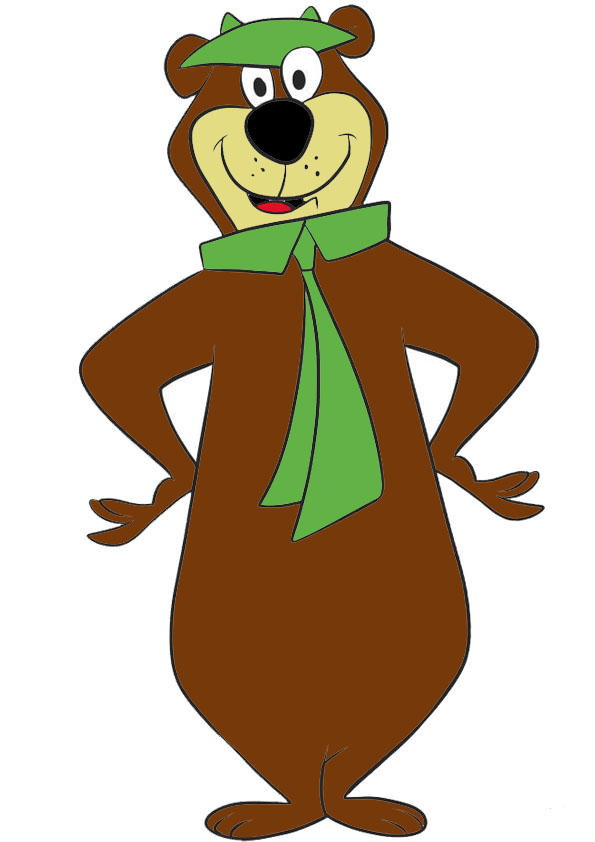
I'm sure Yogi will ignore his biological imperative to eat 
anything remotely edible, like humans, before his winter hibernation, 
and just settle for the ham salad sandwich in the picnic basket.


I'm certainly not immune - already in this series I've referred to these inanimate objects by masculine pronouns, and called out poor Magnus from yesterday's entry for "killing" things that aren't really alive.  So it seems inevitable that we would project our human feelings, emotions, and behaviors onto mechanisms that seem even vaguely human.  Behold Astroboy - a 1960s icon:


He's so cute and non-threatening - and very human in appearance!

Even the less human robots of the 1960s were getting a makeover - not collagen injected into the lips, rather humanity injected into their circuits:


Lost in Space was a rather lame sci fi update of Swiss Family Robinson, but it did have a robot!

The creators of these kindlier, friendlier robots would seem to be influenced by Isaac Asimov's classic 1950 collection of stories, I Robot (not ever to be confused with the awful recent movie of the same name).  In these tales, robot behavior is guided by three main principles:

  1. A robot may not injure a human being or, through inaction, allow a human being to come to harm.
  2. A robot must obey the orders given to it by human beings, except where such orders would conflict with the First Law.
  3. A robot must protect its own existence as long as such protection does not conflict with the First or Second Law.

While the talented Asimov had no problem subverting these laws to create some wonderful stories, for the most part these rules, and those like it, seemed to give those crafting the images of robots in popular culture the opportunity to rein in the seeming independence of robots.  Instead of robots roaming the countryside creating havoc, Asimov shifts the locus of control back to humans - now if a robot acted up, it's due to bad human management, not robot rage.  So "good" robots, the friends of mankind, began showing up more frequently in film and literature.

However, that really only created a bifurcation in the popular views of robots, not a complete shift.  Many writers an artists essentially told Asimov that "we don't need your stinking rules", and "Good" and "Bad" robots both became mainstays in American culture through out ensuing decades.  For example,  a few years after  the "Lost in Space" robot was helping out young, inquisitive Will Robinson on a weekly basis, these guys were running amuck in England, beginning in 1975:

Really,  really nasty bits of handiwork!  

Daleks were a breed of robots of the old school,  created by a unpleasant character named Davos with the single goal of taking over the universe.  Some  purists may claim Daleks are actually cyborgs - part organic (in this Kaledian) and part robot.  But there really is no discernible Kaled left in these gizmos - so enough with the quibbling!  Fortunately, The Daleks had their plans were routinely thwarted by Dr. Who (or, more accurately, The Doctor) through the Doctor's many incarnations.  

In their highly-focused pursuit of their destructive goals, Daleks foreshadowed what was to be the penultimate film battle of the robots.  But first, a little description of the this highly-efficient, anti-human, robotic killing machine:

Unnerving, but well put, Kyle Reese!

Remember the Uncanny Valley?  James Cameron's Terminator was that concept - both human-like and oddly strange - brought to psuedo-life.  Confronted with a gleaming robot wrapped in human skin, uneasy audiences were at times amused by the creature's social awkwardness and horrified by the Terminator's murderous pursuit of Sarah Connor.  In this, the Terminator was the ultimate "Bad" robot.

That is, until Terminator 2.  Director Cameron cleverly figured out the only thing that can take on the newly-upgraded "Bad" Terminator is a reprogrammed, now "Good" , Terminator 1.0 from the previous film.  Simply put, America's, and the world's,  decades-old divergent views of the nature of robots came to literally clash in one movie:


Rock 'em, sock 'em time!

Has the issue been settled?  Not as far as writers and directors are concerned - or Magnus, Robot Killer, for that matter - far too many possibilities for conflict; both the physical and emotional variety.  But at this point, it is all speculation.  Independently thinking and acting robots remain firmly, and safely, contained in the realm of fiction.  

Meanwhile, in real life, robots plod along daily, cleaning pools and building cars, all at the bidding of their human masters.  Using computers.  That are really just sophisticated counting machines.  Except the computers scientists are programming to pass the Turing test of independent thought - which some may have done already.  Which may lead to more machines thinking for themselves.  Outside of human control.  Which inevitably leads to... tomorrow's entry:  

Man and Machine Part 4 - All Hail Colossus!


Monday, July 7, 2014

Man and Machine - Part 2 - I, Robot!

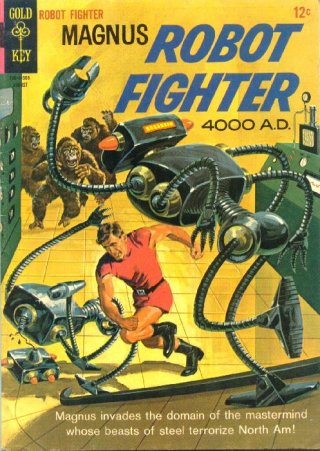
Back in the misty, long ago days of my youth, I actually had several copies of this comic:

All you really to know about Magnus is that he will 
live in 4,000 AD, robots will have taken over, and he
is the kind of guy who holds a grudge and wears a mini-dress.  
Not sure what's up with the apes.

Magnus really wasn't that complicated - he just really liked killing robots, if killing is the right term (more on that later).  In that, he embodied the last vestiges of the deep animosity and suspicion of machines that characterized much of the general reaction to the industrialization that formed life and culture in much of the 19th and early 20th centuries.  As these machines replaced humans as the primary source of labor, there was growing speculation among thinkers and writers that someday these mechanisms could be designed to think independently in some fashion - perhaps too independently.  Additionally, what if these free thinking machines cast off their chains, so to speak, and began moving about independently as well?  The answer, as our friend Magnus knew well, is Robots!

Now, there are many forms of robots.  In fact, this guy is running around my pool right now sucking up dirt so I don't have to (I should probably rewrite that last sentence):


Sort of a very damp R2-D2

Like our ancestors of the Industrial Revolution, we find there is something disturbing about a mechanism seeming to operate on its own - the above pool cleaner looks benign, but it still creeps me out when it bumps my leg when I'm in the pool.

What really seems to stir up emotions are the robots that look humanoid-like: Intentionally designed with some form of a head, torso, arms and legs.  Czech writer Karel Capek gave us the term "robot" in his 1920 play R.U.R.  The term was immediately adopted and used a repository for all our dreams and nightmares regarding technology:

Poor Maria (from Fritz Lang's silent classic Metropolis):


or this:

I'm guessing it won't be cleaning the pool.

This type of revulsion at the "other" is what Sigmund Freud called  "The Uncanny", a situation where something seems familiar but there is something not quite right.  In the article Freud mentions the need for audience members of the opera Tales of Hoffman to grapple with whether or not a doll character is living or some form of automation.  Writer Dave Bryant recounts Japanese robotocist Dr. Masahiro Mori term for this uneasiness (which the scientist actually plots): The Uncanny Valley:
This chasm—the uncanny valley of Doctor Mori’s thesis—represents the point at which a person observing the creature or object in question sees something that is nearly human, but just enough off-kilter to seem eerie or disquieting.
The "Uncanny Valley" effect isn't just an artifact of robots and opera; As the New York Times reported on November 10, 2004, film directors working with the first forms of computer-generated images (CGI) found that while audiences embraced anthropomorphic fish and other animals, they had issues with more human images:  
The largest intractable problem with "The Polar Express" is that the motion-capture technology used to create the human figures has resulted in a film filled with creepily unlifelike beings... With their denatured physiognomy, the human characters in "Polar Express" don't just look less alive than Gollum; they look less alive than the cartoon family in Brad Bird's "Incredibles." It's baffling that Mr. (director Robert) Zemeckis, who can make the screen churn with life, didn't see how dead these animated characters look. (The New York Times)
So, in a strange sort of irony, the more human-like a robot becomes, the more we fear and loathe it, unless it becomes and remains truly undetectable from actual humans:

Damn- I was really pulling for those crazy, mismatched kids...

Tomorrow - Robots get a makeover, and an un-makeover, at the same time... Man and Machine Part 3 - More Robots!

Saturday, July 5, 2014

Man and Machine - Part 1

My daughter has said more than once, "when the computers take over..." to which I generally reply, "when they take over?"  As I told her today, YouTube cat videos are proof positive that they have taken over and they are using social media and performing felines to keep us in a state of blissful ignorance.

Maybe a little overstated, but the fear of machines rising to dominance and initiating a life-and-death conflict with their creators is an old one.  In fact, some elements seem to mirror the Biblical creation story - even further.  In John Milton's Paradise Lost, Lucifer rebels against his creator and causes havoc both in Heaven and Earth, luring Adam and Eve to similarly rebel.  None were machines or robots, of course, but the fear of creations opposing their creators with the creators losing all control is a common narrative thread.

Lucifer: Better to reign in Hell than serve in Heaven


Fear of non-thinking machines is not nearly as old as Mankind's fall from grace, but it still have a long history of animosity and conflict:

In the eighteenth century, a series of inventions transformed the manufacture of cotton in England and gave rise to a new mode or production -- the factory system. During these years, other branches of industry effected comparable advances, and all these together, mutually reinforcing one another, made possible further gains on an ever-widening front. The abundance and variety of these innovations almost defy compilation, but they may be subsumed under three principles: the substitution of machines -- rapid, regular, precise, tireless -- for human skill and effort; the substitution of inanimate for animate sources of power, in particular, the introduction of engines for converting heat into work, thereby opening to man a new and almost unlimited supply of energy; the use of new and far more abundant raw materials, in particular, the substitution of mineral for vegetable or animal substances. These improvements constitute the Industrial Revolution. [David Landes, The Unbound Prometheus, 1969](via The History Guide)

Improvements, unless you happen to be one of the human's having his or her skill replaced.  There's quite of bit of fear of becoming obsolete in our fascination with machines, robots and computers.  There's also the psychological revulsion at the strange, alien, "other" - machines that look nothing like the weavers and blacksmiths they replaced, and seeming operated on their own with the turn of a steam-powered crank or lever; they did their master's biding tirelessly, remorselessly, beyond concern, connection, and with only minimal cooperation with their human counterparts.


The fear of replacement, the devaluing of human labor, and, essentially devaluing humanity itself, soon became the stuff of philosophers and theorists such as Karl Marx:
The factory lord has become a penal legislator within his own establishment, inflicting fines at will, frequently for his own aggrandisement. The feudal baron in his dealings with his serfs was bound by traditions and subject to certain definite rules; the factory lord is subject to no controlling agency of any kind. (Marx in an address to the International Workingman's Association in 1868)
And, as literary history shows, what troubles philosophers usually comes to trouble their poor cousins - writers, especially those who write in the realm of speculative, or science, fiction.  It wasn't long before the question was raised - "if machines can duplicate and even replace human muscle, could they do the same with the human brain?"

Part 2 Tomorrow... I, Robot!


Tuesday, July 1, 2014

Graffiti & Street Art: Biting Wit and Social Commentary

This isn't what I planned to write today, but I have been thinking  a lot lately about the witty bits of graffiti and street art I've been seeing on the web in recent days, and how it incorporates social commentary with cleverness and witty appraisals of the social scene.

Graffiti seems to fall into several broad categories.


  • Pornographic/scatological (the kind usually reserved for bathroom walls - we really don't need an example, do we?) 

  • Works of art (that can include "tagging", but usually not).  This is impressive:
  • Stenciling and "plain text" type of comments:
  • And the kind I'm considering here - additions, addendums, and annotations to existing messages.


In other words, this sort of thing:


Some quick spray paint work, and two utility boxes share an embrace.  Seems kind of simple - but is it?  Is it too far-fetched to wonder why the artist chose this particular design?  There really is nothing about a pair of plain utility boxes set in a field that naturally indicates the need for a hug.  Perhaps it is more than a clever design - rather, a comment on how we humans often find ourselves side-but-side, yet afraid to share even the most basic type of intimacy with another person.

Then there's this:


A clever play on words, certainly.  But is it also a comment on how "parking" is replacing the green spaces once reserved for "parks"? It reads that way to me.

This isn't to imply everything has an underlying social meaning, some of these annotations are really just a chance to be silly with no real subtext:


Still, if you hold constructionist/constructivist views, believing that we as individuals and as a society construct meaning and apply them to objects, you have to start  looking differently at these alternations that to seem combine biting wit and social comment:


-30-

Thursday, June 26, 2014

Time and Achievement

I love reading the schedules well-known creative people have written down over time; I then try to find similarities and patterns to their life and work balances.  Some types of jobs and lives lend themselves to more routine habits, others seem random and chaotic, yet produce results.  Below is a sampling of schedules, quotes about work habits, etc.  Looking at them, several things become apparent:


  • Achievements are not the result of luck - quite the opposite in many cases.  Creative people often face the worst kind of misfortunes - poverty, illnesses, personal tragedy, and yet keep producing.  Work as therapy?  Maybe.  Uncontrollable compulsion to create?  Probably, to some degree.  But all extend effort in the service of their art, and that means...
  • Sacrifices must be made - Most, if not all, creative endeavors are solo endeavors.  Even in so-called teamwork, there's usually individuals creating individually and then stitching together the pieces collectively.  Not in all cases, of course, but generally speaking it seems creation and solitude go together.  Therefore, there has to be a sacrifice of time, interactions with friends, and other possibilities.  
Let's see how others do it:

Ben Franklin's Daily Schedule (From the Beanstalk Foundation.org):


Ben's schedule seems congenial enough, but an analysis reveals just how much time Ben devoted to effort, if not literal work.  The Work columns add up to eight hours, and then there are subtle things that indicate additional activity:  "prosecute the the present study," is not the same as chill in front of the TV,  and a two-hour lunch seems pretty sweet, until you realize "overlook my accounts" is not usually conducive to a worry-free meal.  For hours in the evening for "Supper. Music or diversion, or conversation." sound relaxing enough.  What does "Put things in their places" include?  It also seems as if "Examination of the day," is going to involve some mental effort, so maybe Ben's free time isn't as free as we might think.  Seven hours of sleep and right back at it.


RJ Andrews at Info We Trust, applied his engineering talents to create an interesting "wheel of time" diagram showing how a sample of creative people use their time.  First, the key, or legend, to the diagrams:

Creative Routines Legend

How it works:


Here's a larger diagram showing a large selection of creative people going about their daily routines.

Andrews' conclusions from his work:

Comparing the routines of these creatives is fascinating. Some work in the early morning, some work better late at night. Many begin their day with coffee and use tobacco and alcohol. Considering that our modern concept of exercise was not developed until the mid-20th century, it is fascinating how many of these people spent their afternoons taking vigorous walks.
There are hundreds, maybe thousands, more.  Probably the main point to leave with is there is not a magic time, place, or situation in which to be creative.  Perfectionists such as myself must always battle the desire to wait until everything in our lives line up like some mystical formation of stars and planets before beginning some great effort.  It's creation that forms the schedule, not the other way around.  E.B. White (from the great site Brain Pickings) said it best:

A writer who waits for ideal conditions under which to work will die without putting a word on paper.


Wednesday, June 25, 2014

How I Got This Way

I'm not a big fan of talking about myself, but I have been getting quite a few questions lately about how I lost so much weight (over 50 pounds as of today, from about 255 - I didn't have the heart to weigh myself at my heaviest -  to 205) and so quickly (around six months).  At 6 feet in height, I am still a little over - my target is 180.  I will get there, I just need to stay focused.  So how did I make this change?  Here's how:


  • I stopped lying to myself - I kept looking in the mirror and saying, "not too bad," or when I didn't eat well, I would say, "I'll start tomorrow..." It was all bullshit, and my awakening came when I saw a picture of myself, old and fat, and I couldn't lie to myself anymore.  I also had one good friend who called me out on my bullshit constantly and that helped me start looking at all the areas of my life:
  • I did a hardcore self-assessment - I tried to be a brutally honest as I could about everything in my life; what relationships in my life were working, and which were not, and how much did I have to do with both situations?  How did I become this way?  Who was I, really?  What were my core values? What essential parts of my personality and tastes had I given up over the years in attempts to please others?  What self-image did I want to have?  What were my goals, and was I really ready to dedicate time, money, sweat and pain to reach those goals?  These are just some the questions I had, along with compiling a long list of shortcomings and taking ownership of those.
  • I changed my appearance to match who I wanted to be - This sounds a little silly and vain, but was really essential.  I didn't want to be overweight, and I didn't want to be stereotypically old.  I'm in my fifties, but I looked 20 years older and was very overweight on top of that.  So I dyed my hair and grew a beard - first steps in becoming the person I wanted to be.
  • I became a vegetarian - in one visit to the doctor, he basically told me the tests showed everything bad was too high, and everything good was too low.  I had high blood pressure, high bad cholesterol, high glucose readings (on the way to diabetes), etc, and low good cholesterol, etc.  I didn't want to go on medication (although I consented to a low dose of blood pressure medication), but I wanted to avoid the other issues through diet.  Cutting out animal fat and carbs, and reducing dairy (I will eliminate it soon), sugar and processed food made me feel better and more energetic immediately.
  • I started taking garcinia carbogia - My parents were in town for a visit, and my mother is a big Dr. Oz fan.  He is a big promoter of garcinia, but I had my doubts.  I read about it online in some real medical journals, and it seemed to have some validity as a natural weight loss method.  I started taking it and it worked.  Don't worry, this isn't some "sell you pills" kind of thing; take or not, it is up to you.  It may not work for you, I don't know.  All I can say is it worked for me and I started dropping weight immediately.
  • I started exercising a lot - Because of the weight loss and increased energy, I started looking at exercise programs that would work for me.  We had a mostly-dormant membership to the YMCA that I started using it regularly.  Just a note: at the start, I couldn't do much of anything.  It was actually pretty discouraging, so I just decided to do what I could and just keep at it, and slowly, very slowly, it started getting easier, and it is still getting better.  But I was so discouraged by my lack of fitness that I almost gave up a few times.  My advice is just keep at it even when it seems nothing is happening.  It is very slow, but it does happen.  Just force yourself to go and workout, and find something online or with a trainer or whatever works for you.  Just-keep-at-it!
  • Grace and forgiveness - I routinely fail at all of the above.  Hell, some days I forget to take the blood pressure medicine!  But I learned to forgive myself while not excusing myself.  I may say, "I didn't take garcinia today and I felt especially lazy and skipped the gym, so it happened."  I don't beat myself up, but I also know I have to correct this if I want to reach my goals, so no excuses - I made a poor decision, so now its time to get focused and back on track.
  • Lastly, do it for you, and you alone - A lot of these "I lost weight" kind of things talk about the need for support, and while support through these changes is nice, what if you don't have any?  Or even people trying to hold you back (many people fear change in others - it can convict them about their own lifestyle choices).  I say screw them, and screw the need for support.  You have to do this for you, and you have to realize that you might lose people you thought of as friends along the way.  Screw them as well; if they were your friends that would be with you all the way, and not be an anchor in your life.  You'll find the right people for the new you along the way.
So that's it.  It has been hard and painful, both physically and emotionally.  Nothing worthwhile is consequence-free; I've had to be more authentic with myself and other people in my life, and it hasn't always been smooth, to put it mildly.  But the rewards have been worth the pain - I'm healthier than I have been in 25 years, I have a better relationship with others and, in some ways, I feel as if I have been set free from a physical and mental prison of my own making.  I still have a long way to go, but I know without doubt that I will reach my goals.  Believe me, there is nothing special about me, so you can reach your goals as well, just stay committed!


Good Luck - here are some websites I find especially helpful in keeping me focused and moving forward:


Monday, September 30, 2013

Sleepy Hollow

It is hard to feel much more than ambiguity toward the new television program Sleepy Hollow.  It is a modern-day version of the Washington Irving story - except it bares no resemblance to the original tale other than some character names.  First of all,  Icabod Crane 1.0 was not a charming Brit  with flowing locks and a manly scruff of beard.  The Irving character was devoid of any charm whatsoever:
He was tall and exceedingly lank, with narrow shoulders, long arms and legs, hands that dangled a mile out of his sleeves, and feet that might have served for shovels. His head was small, and flat at top, with huge ears, large green glassy eyes, and a long snipe nose, so that it looked like a weathercock perched upon his spindle neck, to tell which way the wind blew. To see him striding along on a windy day, with his clothes bagging and fluttering about him, one might have mistaken him for some scarecrow eloped from a cornfield.
Okay, I guess 18th century protagonists needed less in the way of  chiseled good looks.  Icabod's character deficiencies go beyond the physical. He courts the local Bachelorette with an eye to greedily acquiring her considerable inheritance of property and turning it into cold cash.  Furthermore, he proves to be a coward, fleeing in fear from the apparition of the Headless Horseman,

The television series upgrades poor Icabod's looks and motivations while creating a mashup with Irving's other famous tale, Rip Van Winkle.  So, now dreamboat Crane is a Brit spying for George Washington who is mortally wounded after removing the Horseman's head, and his witch wife Katrina puts a spell on him that makes him sleep for 240 years.  Now awake, this Revolutionary War Mulder teams up with a modern Scully to go ghostbusting.

Story needs some clarity, but the narrative is interesting and the cinematography is properly creepy, so it may be worth watching someday.  But I pity those people who pick up the book hoping for a romantic stranger and who encounter "a scarecrow eloped from a cornfield."